Back to ProjectsBack to Projects
2D Simulation of LMO Batteries
Research project, Panat Lab · Carnegie Mellon University
Introduction
Lithium-Ion batteries are transitioning toward cobalt-free alternatives due to sustainability and cost considerations. Lithium Manganese Oxide (LMO)-based electrodes, despite their advantages in cost and environmental impact, have limitations in cycling capacity and performance. Accelerating the design and optimization of LMO-based electrodes requires rapid, reliable, and comprehensive simulation methods coupled with advanced additive manufacturing techniques.
Methods
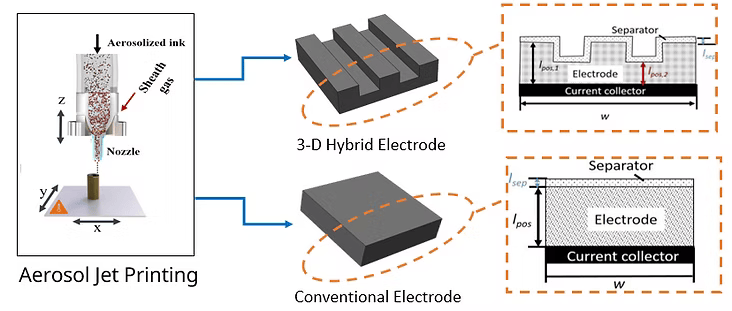
- Simulation approach — Utilized the Doyle-Fuller-Newman model in COMSOL Multiphysics to conduct detailed electrochemical simulations, employing porous electrode theory and concentrated species theory to model charge and mass balance accurately within the electrodes and electrolytes.
- Manufacturing technique — Used high-precision Aerosol Jet printing to produce 3D-structured hybrid electrodes with fine feature resolution (10–15 µm), and compared their performance against conventional, planar electrode configurations.
Results
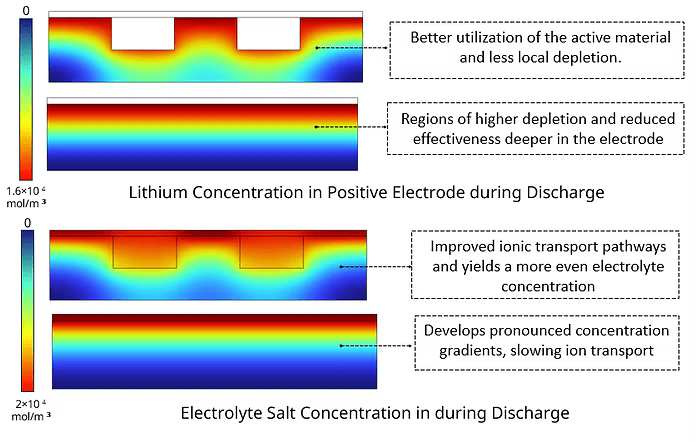
- Improved Ion Transport — 3D-structured electrodes provided significantly better lithium-ion and electrolyte salt concentration profiles, ensuring even electrolyte concentrations and enhanced ionic transport pathways — reducing lithium concentration differences within electrodes by approximately 95–96% and greatly mitigating material polarization effects.
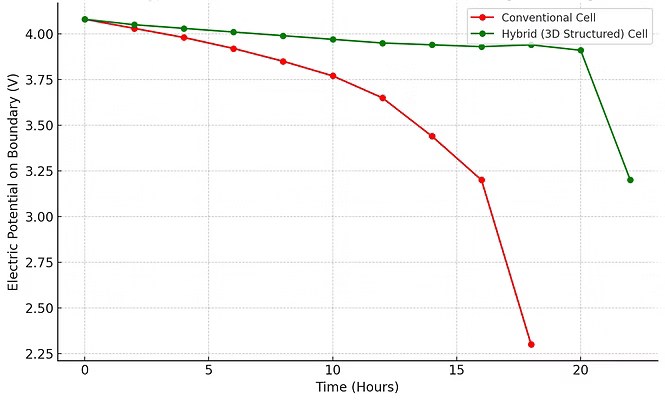
- Extended Voltage Stability — 3D electrode configurations achieved prolonged stable voltage profiles during discharge compared to conventional layouts, clearly demonstrating minimized internal polarization.
- Enhanced Material Utilization — Demonstrated higher active material utilization through optimized electrode geometries, resulting in improved energy density and efficiency.